
Let me start by saying that I still think there are plenty of warning signs that the Employment picture and potentially the economy as a whole are showing signs of increased fatigue- so the note below does not change that medium-term view.
Notwithstanding that, we know that any one Employment report can come out at any level.
There are 2 reasons to suggest that Friday MAY NOT deliver the employment report most beneficial for those who are long Fixed Income and curve steepeners.
1. The historic analogs of 1990, 2000 and 2007DO NOT SUGGEST that this will be an "awful" number.
2. The JOLTS numbers this week could also suggest some respite.
What do the analogs say?
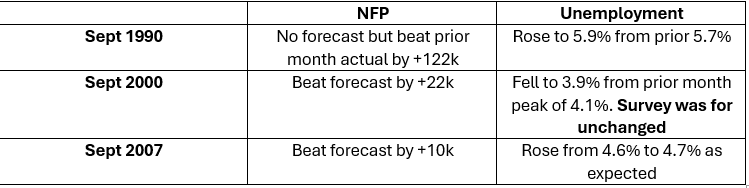
No NFP forecast number available for 1990, but number handily beat prior month actual print.
Both 2000 and 2007 we saw the actual beat expectations. As an aside, we should remember that 6 of the last 7 prints this year have been revised lower- but market clearly focuses on new release.
Unemployment rose 2/10ths in 1990, fell 2/10ths in 2000 and rose 1/10th as expected in 2007
What has happened in the last year when JOLTS has printed higher?
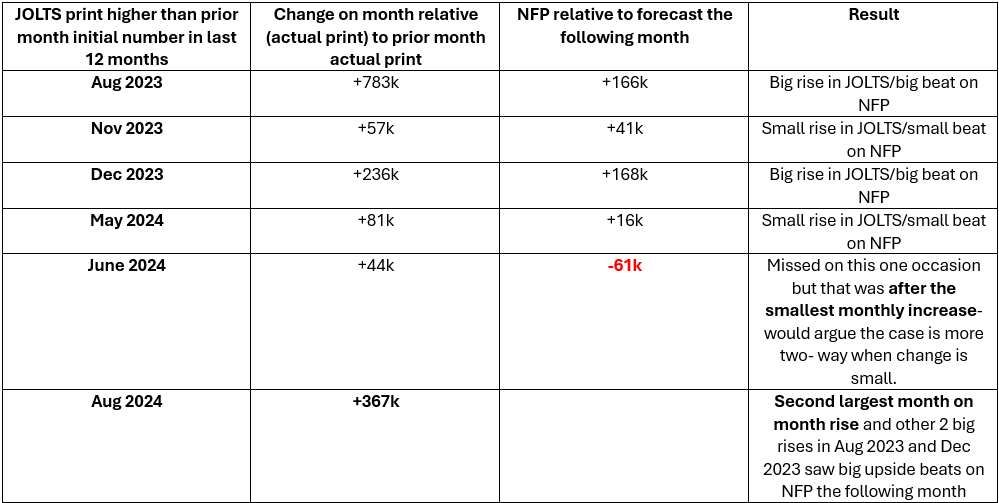
On 4 of the 5 times that JOLTS have printed higher in the last year (actual versus actual) the subsequent NFP has had a topside beat. The one miss was after the smallest bounce in JOLTS while the 2 large up months on JOLTS saw outsize beats on NFP.
The JOLTS number this time around was the 2nd largest rise in the last 12 months (Month on month actual)
The bottom line here suggests that the bar is low for a topside miss this month on NFP albeit the unemployment rate performance has been mixed (rose 2 of 3 times) Right now the market seems to focus more on NFP and with the recent Bostic comments that 100k looks to be the dividing line between 25 and 50 bp's move it will likely have primary focus.
If we do see a rise in the unemployment rate, we also need to look at the "rounding". The fall last month from 4.3% to 4.2% was really a fall from 4.25% to 4.22%
Bottom line it appears the market is still long Fixed income / long duration and long curve steepeners.
As a consequence, it feels that in 2 out of 3 results these trades could get hit- on a meet or a beat (as they did in the first 2 weeks of October 2007 with the 2-year yield rising 10 bp's on the day of the employment report and yields continuing higher and curves lower until Oct 15th.)
On the other side, if the numbers are weak, you would suffer only opportunity loss (if you exited these trades before) but have more certainty to re-enter these core trades thereafter.
For me the risk reward to hold these trades into this number is badly skewed against you and the sidelines feel like the most comfortable place to be with dry powder to re-establish in the weeks ahead.