The USD remains strong and looks like it could strengthen further. What does that suggest in terms of what we are seeing in markets?
FX
USDJPY has 3 big levels
160.20: Trend peak on 17 April 1990 (Strong tightening cycle by BOJ and big reversal in Nikkei)
160.17: Peak posted on 29 April 2024
160.48: New highs posted this morning- 3rd time a charm?.
With no BOJ policy adjustment and the USD trading overall bid there is nothing of note in terms of resistance on USDJPY before 164+ while the longer-term chart still suggests 175 eventually.
The other bona-fide low yielder (CHF) is also under pressure with next resistance on USDCHF at .8988-.8993 and then .9946. Major resistance is at .9224-44.
The double bottom on the DXY remains intact and targets at least 106.30-50
USDMXN is once again rallying and is back pushing the 18.19-18.21 pivot. IF this breaks yet again ( Closing basis) then we have to look at its significance as greatly reduced. Watch this space.
Making this USD move easier is the price action on USDCNH and China yields
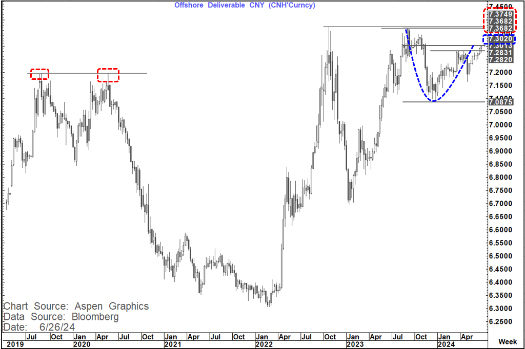
USDCNH has decisively broken above 7.2820-30 resistance and is testing the 76.4% pullback level at 7.3020. Above here leaves only the double highs at 7.3682-7.3749 as resistance.(2022-2023 highs)
The last time we had a double top in USDCNH was 2019-2020 and we never went back to those levels again until late 2022. If we do test that area then like USDJPY...the 3rd time is likely a charm and with USDJPY through its long-term levels there has to be a big danger that CNH follows suit.
Before our eyes the CNH/CNY is becoming a low yield/funding currency also.
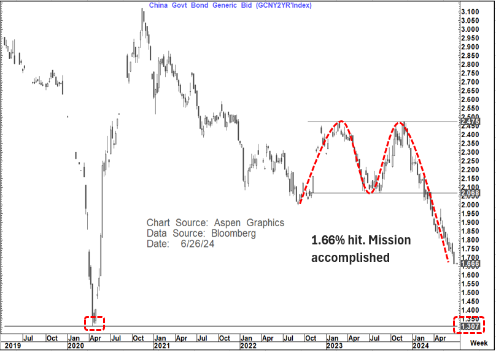
The target of the double top on the Chinese 2 year yield was 1.658-1.6610%. The low posted overnight was 1.663%- so mission accomplished.
However, what IF it stars to move decisively below 1.66%.
Then there is no support left until the trend low in April 2020 at 1.31%.
It is hard to look at these charts and be bullish CNH or for that matter the Global economy.
Yields
US yields are higher overnight
This has led to the possibility of bullish outside weeks on both the 2's5's and 2's 10's curves. The weekly closes to watch are minus 44.7 bp's and minus 45.6 bp's respectively...but a note of caution.
1. It is only Wednesday
2. We have PCE on Friday
3. This move at this point is Technical. We got a new 2 year yield overnight (30 June 2026 maturity) which had a roll of 4 3/8 bp's while the new 5's tonight will have a roll of only 3/8 of a basis point- so it suggests some caution in reading too much into it at this point, even if it does materialise.
However, this tone on US yields and on the USD is clearly not so supportive for Commodities and in particular precious metals.
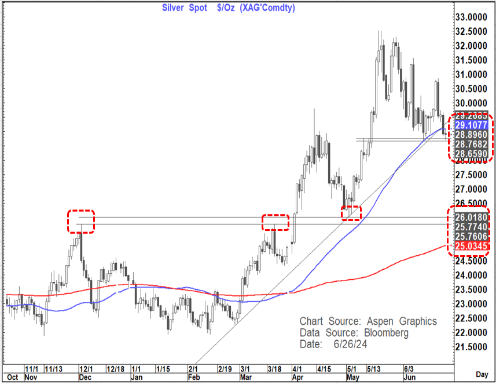
Yesterday Silver closed below the 55 day MA for the first time since Feb 2024 (2 years and 4 months) with a wide gap to the 200 day Ma at $25.03. There is some immediate support at $28.65-$28.77 and If that gives way then losses towards $25-$26 look likely.
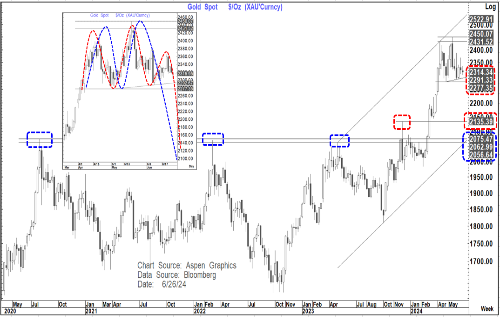
The levels on Gold are a bit further away but starting to come into focus.
This can both be viewed as a head and shoulders top with a neckline at $2,293 and a double top with a neckline at $2,277
A break of this range would suggest material losses towards $2,105-$2,125 just above the previously pivotal area at $2,063 to $2075
Copper continues to trade heavily and there seems little reason not to expect a move towards $400.
200 day Ma is $401.55
200 week Ma is $398.77
55 week Ma is $397.23
Horizontal support is at $394.70-$398.77
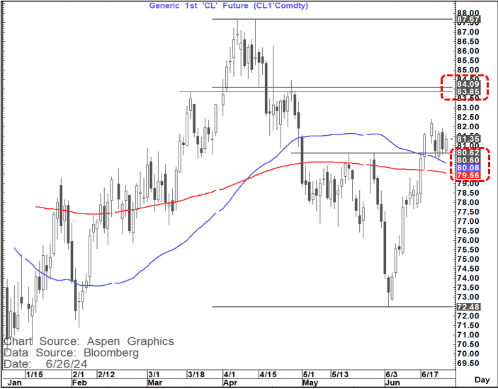
WTI still remains above good support at $79.56-$80.62.(For now) While this area holds the danger remains of a move above $84.
We need to see WTI back below this lower range to suggest that we Amy have a material turn lower in Oil.
Equities
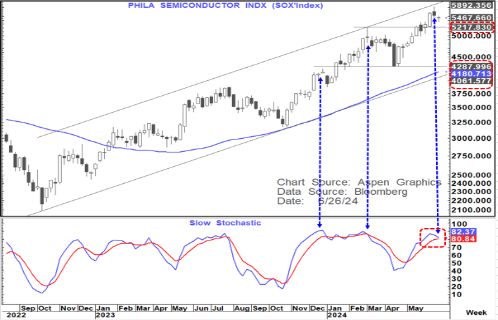
The SOX Index (Philly Semis) still has the possibility of triple negative momentum divergence on the weekly chart and If this happens the suggestion would be for a material correction lower.
As we stand this morning however, we do not have that 3rd crossover anymore. We need to see how the week closes in that respect.
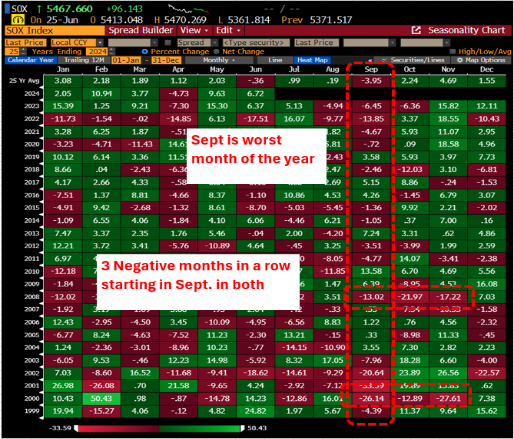
Historically (As per the heat map below) June is actually 1 of 2 months over the last 25 years that averages negative (It remains in strong positive territory on the month).
However the month that has the worst average perforemance (By far) is September. This suggests that it might still bee early to have a bearish bias.
Over the last 25 years September has averaged minus 3.95% and has been a negative month 15 times (60% of the time)
It has also closed down in the last 4 Septembers in a row.
The record here is 5 Septembers in a row from 1999-2003 and as you know I am very "locked in" to 1998-2000 as having a number of similarities to today.
-Crisis/ease 1998 (Russia/LTCM/Asian Crisis)
-Tightening policy (1999-2000) taking rates to 6.5% and real rates to about 400 bp's. The Equity market ignores the Stubborn Fed throughout 2000 until the real wobbles begin in September leading to SOX falling 3 months in a row.
This as the employment picture starts to deteriorate from June of that year (NFP prints +11 k in June and negative in July and August (actual numbers) )
The Fed eventually began easing in Jan 2001- the first of what turned out to be five 50 bp cuts between January and June that year.
Overall backdrop
We have many moving parts at the moment but for now the 2000 roadmap seems the closest comparison that we have to today's backdrop.
The main exceptions being Geopolitics and politics which are much more "fraught" today than then with multiple flashpoints (and growing) around the world.
The other big difference to then is the debt side of the equation. In 2000 the US debt to GDP was about 33% and a nominal number of about $5.7 trillion. In 2023 that was $33.2 trillion with a debt to GDP ratio of about 122%.
Net interest payments are rapidly climbing the ladder in terms of top expenditures in the budget (13% this year) exceeded only by Medicare (14%) and Social security (21%).
None of these figures give me increased comfort when comparing today to 2000 and continue to suggest to me that difficult times lie ahead.
This continues to fit with the long term economic cycle of the last 50 years with notable cyclical downturns in 1972-1974+17 , 1989-1991+17, 2006-2008+17, 2023-2025??.
Stay safe
FITZ