In late 2021 in my last life (with Citi) we had a trader and strategy meeting where I was articulating the view that the Fed was clearly behind the curve and that we had the building blocks to create more sustainable inflation than had existed pretty much in my whole career.
I remember a colleague "piping in" with the comment (not exactly word for word but as I remember it)...
"How can you be so arrogant to believe that you know better than the Federal Reserve"
My answer (verbally...my internal answer might have been slightly different) was that I did not think I knew more than them but nothing I looked at suggested that this would be the "transitory inflation that they expected. We agreed to differ. We were in a world where we had failed to sustainably deliver an inflation rate of even 2% for pretty much a quarter of a century and it was pretty much accepted that inflation in the 21st century was dead,
In fact, ironically in my December 2021, "12 charts of Christmas" publication I had "predicted" that in 2022 Core CPI could hit 6.6%.
That publication is not a science but rather a view of what the big picture charts (fundamental (Techamental) and technical were suggesting. In Sept 2022 we hit and peaked at 6.6% Core CPI.
In that respect it was the chart below that I was looking at.
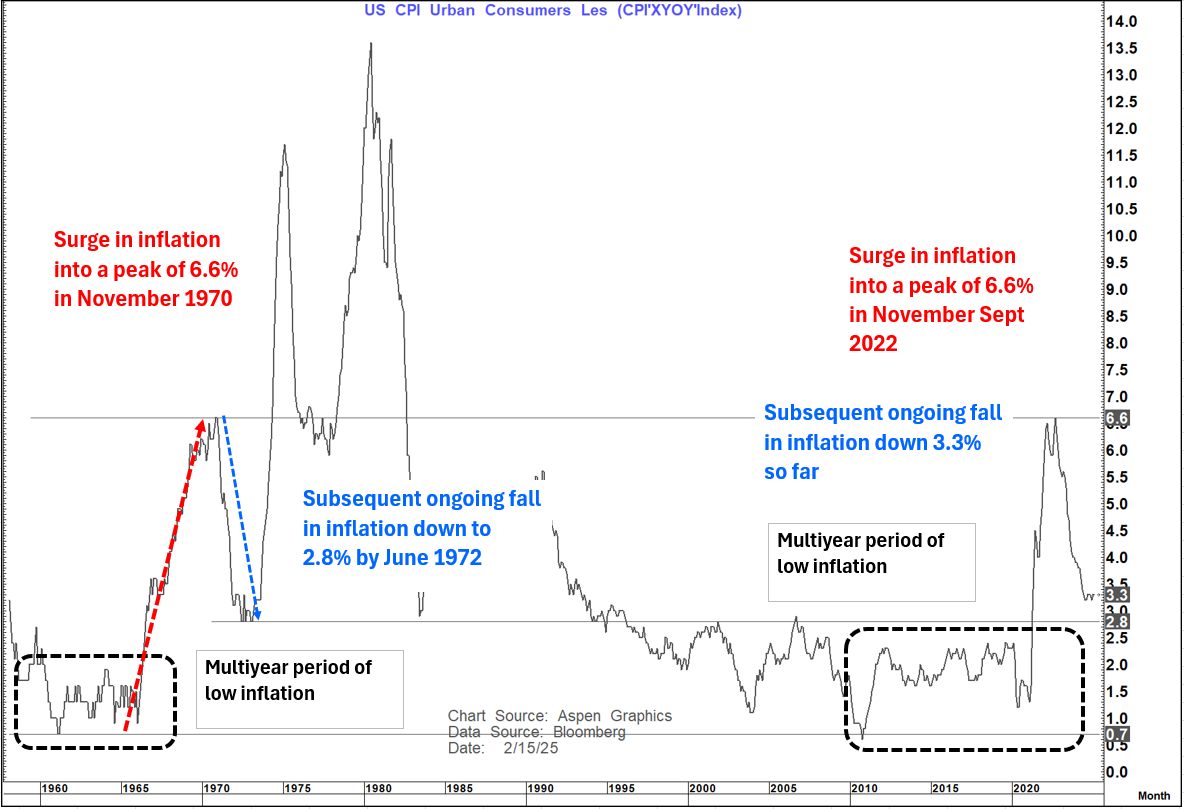
We know that from mid 1973 onwards we saw inflation pick up strongly again...but I will come back to that.
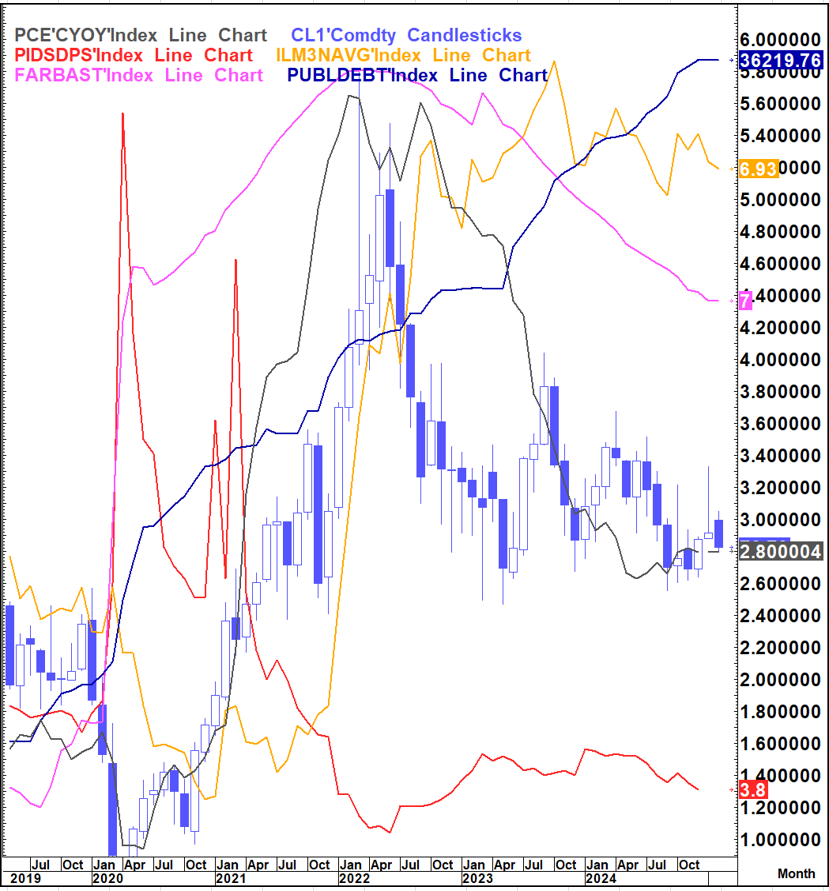
Let's go back to the inflation dynamic seen this time....and switch to Core PCE as that has been the preferred Fed measure since the Greenspan days. Below is a chart of:
Core PCE
Oil
The savings rate
The 30-year mortgage rate
The Fed Balance sheet
The National Debt
Stage 1- The Collapse
In June 2020 CORE PCE was at 0.9%
In April 2020 Oil had collapsed and actually traded to negative having averaged closer to $60 for most of 2017 to 2019
In Jan 2020 the savings rate was at 7%
In April 2020 the 30-year mortgage rate was around 3.5% and had fallen to 2.8% by Feb 2021 . In this whole period the Fed Funds rate stood at 0 to .25% (for a full 2-years)
In Feb 2020 the Fed balance sheet was about $4.2 trillion
In Feb 2020 the National debt was about $23.4 trillion in a ZERO% interest rate World and in March 2020 the 30-year yield hit .70% as unemployment rose to 14.8% in April 2020.
Then we got Covid, (Feb 2020 onwards) and the Russian invasion of Ukraine in Feb 2022 and so started the perfect storm for inflation.
Stage 2- The Surge
Mortgages were refinanced at lifetime lows throughout 2020 and 2021 and only started to normalise towards rates of the prior decade in 2022. This was an ongoing stimulus that then became a pair of Golden handcuffs for consumers.
By March 2022 WTI had rallied to a peak of over $130.
As we gave money away and people went into "Covid Jail" the savings rate rose initially to 32% in April 2020 and after another fall again to 26% by March of 2021.
By April 2022 the Fed balance sheet had risen to $8.94 trillion and the national debt had moved above $30 trillion.
At the same time unemployment had fallen to 3.6% and by March 2022 the JOLTS rate had risen above 12.2 mm providing more that 2 jobs for every 1 person unemployed. Not surprisingly this fueled higher wage growth, and the Quits rate also rose.
"Trapped equity" (and it is still trapped) surged in housing as supply collapsed, particularly in existing homes which make up the lion's share of the market. That fell from an already low 4.5 months in May 2020 to 1.6 months (all time low) in Jan 2022. Put in perspective that right after the GFC in July 2010 that number was 11.9 months.
Also, between the low in March 2020 and Jan 2022 (22 months) the S&P rose 163%. In the following 3 years it is a net "mere" 27% higher.
Shock alert: By Feb 2022 Core PCE had risen to a peak of 5.65% As I said above we probably have had not historical precedent for such a perfect storm of building blocks for inflation. And yet, despite this it "only" went to 6.6% in Core CPI compared to 13.6% in June 1980.
Stage 3- Today.
The 30-year mortgage rate now stands at 6.93% more than 400 basis points off the trend low in 2021 and well above the levels seen for most of the 2010-2020 period (pre covid) where it spent the majority of the time in a 3.5 to 4.75% range. Outside of a sharp rise in unemployment housing equity remains trapped as a consequence of such a high mortgage rate which ironically restricts supply and by definition keeps prices elevated (Counterintuitively)
The Fed funds rate having peaked at 5.25% to 5.50% (post a 5.65% Core PCE that had dropped to 4.3%) is still at 4.25% to 4.5% as Core PCE has dropped to 2.8% and a six-month run rate annualised at closer to 2.4%
Oil (WTI) is now at $70.73 and looks like it could still be headed lower into the mid $60's similar to pre-covid levels.
The savings rate (after some creative adjustments) is off the cycle low of 2% but has started falling again - now 3.8%, which is barely over half the levels we saw just before Covid.
The Fed balance sheet is still high at $6.8 Trillion but has fallen substantially from the April 2022 peak near $9 trillion
The National Debt has continued to rise- now $36.5 trillion and while time will tell, the present administration is looking to rein in the spending side of the budget (spending more than you earn is inflationary- full stop)
Unemployment is at 4% but pre covid (At a time when the Fed was easing) it was at 3.5%. Interestingly it is also higher than where it was in April 2000 (3.8%) JOLTS have collapsed to 7.6mm and we are barely above 1:1 on the JOLTS/Total Unemployed ratio. The JOLTS QUITs rate is back to 2%, substantially below the 2019 levels of 2.4% and even the 2005 peak at 2.3% and 2001 peak of 2.4%.
The ECI (Employment Cost Index) YOY has now fallen from a peak in 2022 of 5.10% to 3.8% a level seen in the 2002-2007 period and at the low of the down move (so far)
The Equity Markets are now by any measure at high valuations and will clearly struggle to deliver the lofty returns seen post covid.
Drill baby drill is disinflationary.
Wars ending (Ukraine and Middle East) is disinflationary
The European economy is disinflationary.
The Chinese Economy is disinflationary- that is the 2nd and 3rd largest economies in the World
AI is disinflationary
Is the new immigration policy inflationary. Highly unlikely as that is a slow fuse burning over a long period of time and in a lot of instances involves low paying jobs that were not endowed with huge discretionary spending capability. This is before we talk about the present Government policy (if implemented) of drastically shedding Government workers which have been a significant driver in keeping the employment picture "buoyed" in recent years.
Are tariffs inflationary? Maybe. Nobody knows for sure because we do not know how much they will be implemented and If they are how transitory they will be.
We do not know if the exchange rate will self-adjust.
We do not know if we will see substitution effect.
We do not know if businesses will have the same ability to pass on prices as in recent years or whether they will have to absorb in the profit margins.
We do not know if a lot of front loading has been done both by businesses and consumers dragging forward economic activity and creating a window of demand that has already help prices up.
We do not know but my gut feel is that this would become more an issue for the equity market than the inflation rate.
We do not know what we do not know
And at the end of the day, it might be even more simplistic than we give this all credit for in the 21st century.
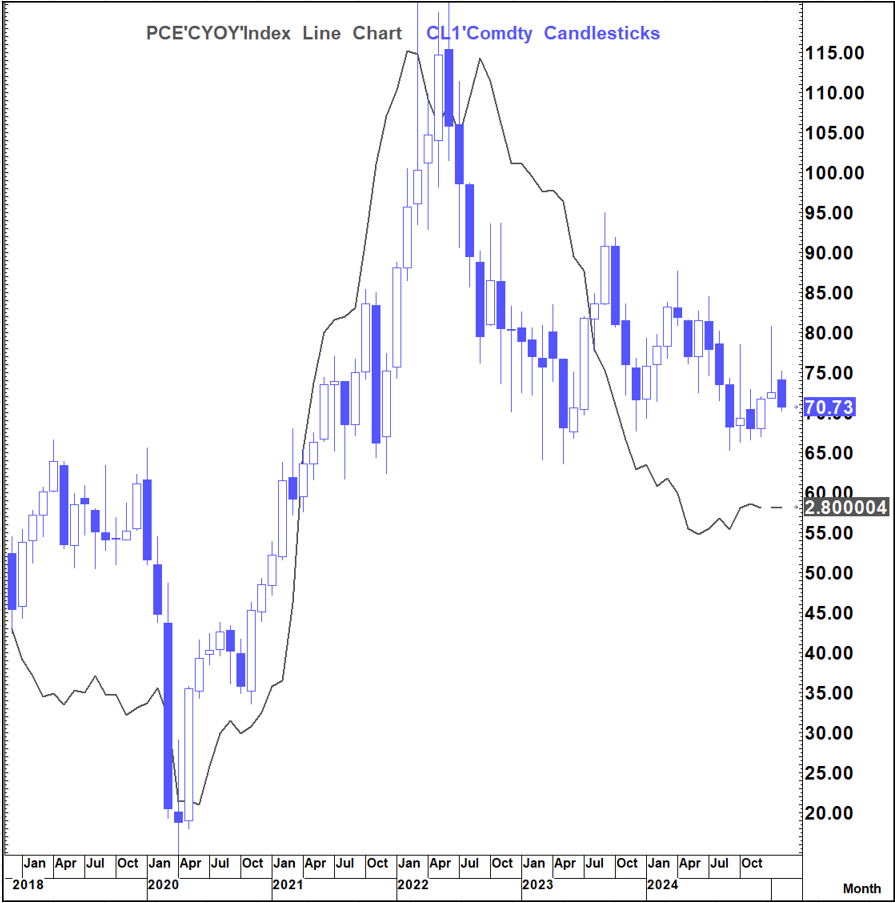
When we go back to the chart above and strip out everything, but the Oil price and Core PCE this is what we get.
It is not a perfect overlay, but it is pretty good and as you know I still believe the technical picture combined with drill baby drill, combined with a resolution to the Ukraine war, combined with an end to the Gaza conflict, combined with the possibility of more normalised relations with Iran , combined with disinflationary impulses in 2 of the 3 largest economies in the world (China and Europe) all serve to maintain downward pressure on Oil.
Yes, all of this may not be sustained but it is very possible bordering on probable right now that they will
Why is this important?
After this inflation surge a lot of market participants and particularly the Fed started to think about the inflation dynamics of the 1970's and the "Arthur Burns mistakes". Even I, at the start of this piece began with a 1970's chart of inflation with reference to today. But I said I would come back to that.
Subsequent inflation came from a very different place
Burns who headed the Fed from 1970 to 1978 (To be replaced by Volcker) is vilified for his mistake in easing policy - particularly in the 1974-1976 period to alleviate a struggling economy and a rise in unemployment.
But to a certain extent we corelate the ease in policy to the rise in inflation. That could be considered true in an all else being equal World.
But all else was not equal.
Between Dec 1972 and Jan 1974, the Oil price rose by about 370%. A major catalyst for this was an embargo on the US by Arab states led by Saudi Arabia in response to the US support of Israel in the Yom Kippur War
Between Jan 1973 and Feb 1975 Core PCE went from 2.7% to 10.2% and started to fall sharply hitting 5.9% by July 1976
Between Dec 1972 and May 1974 the Fed raised rates from 5.5% to 13%.
Into November 1976 Oil prices only rallied a further 6% approximately.
From July 1974 to Jan 1976 the Fed lowered rates from 13% to 4.75% in a very challenging economic backdrop.
From Feb 1975 to July 1976 Core PCE fell from 10.2% to 5.9% even with major Fed easing taking place (But Oil was going nowhere- base effect)
However, Oil prices started to rise again. First gradually from 1976-1978 then in an accelerated fashion from 1978-1980.
From Dec 1976 to dec 1980 the Oil price once again surged 178% (with a major part of the move being in 1978-1980)
In 1979 the Iranian revolution was a huge factor in the disruption of supply
So, from Dec 1972 to Dec 1980 we saw a rise in Oil by a factor of nearly 14 times from $2.50 to $34.50 a barrel. This was also at a time when the US was heavily dependent on middle east Oil.
Core PCE began to rise in earnest from Dec 1976 (5.9%) to Nov 1980 (9.8%) yet from November 1976 to March 1980 the Fed Funds rate also rose from 4.75% to 20%
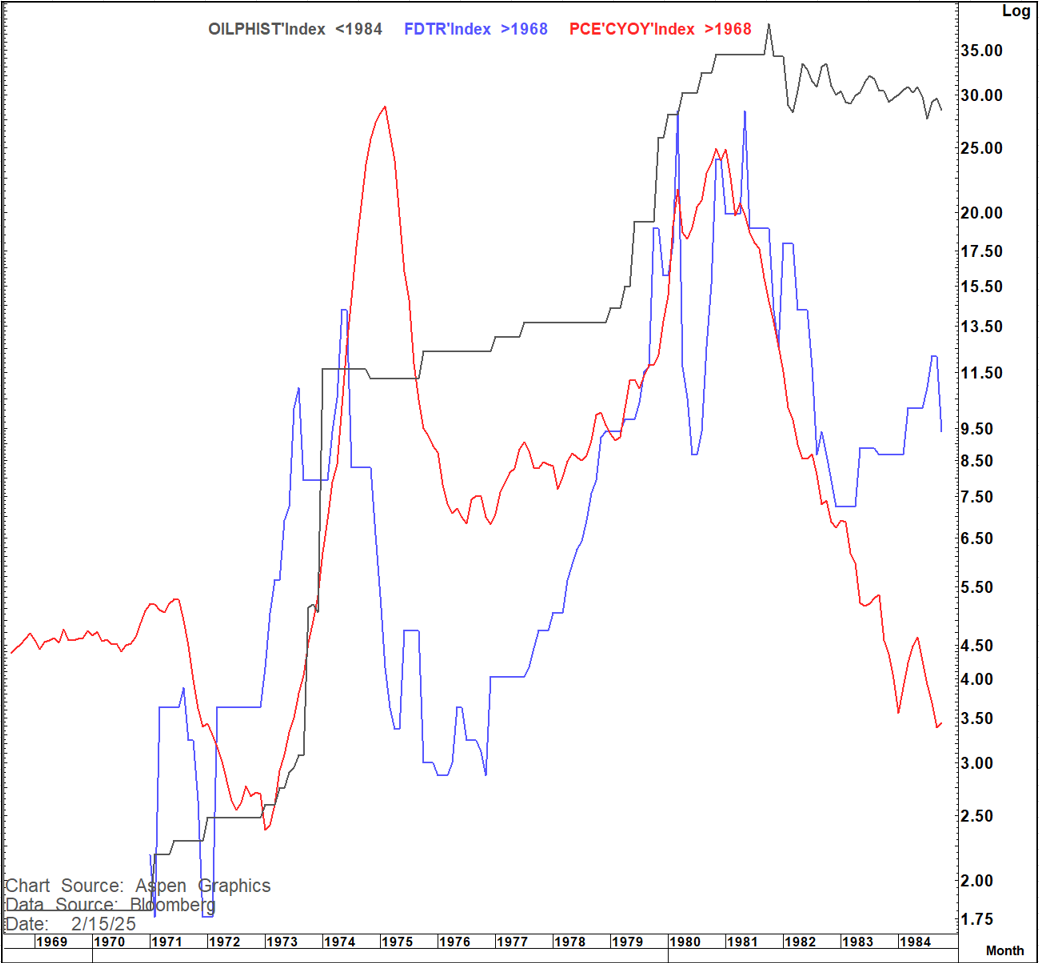
It was not Burn's fault it was Oil's fault.
This is not the 1970's and right now the overwhelming catalysts are for a lower Oil price not higher.
This is also not a 1970's USA- heavily dependent on Middel East Oil. The US is now the World's largest Oil producer Russia is 3rd and Canada 4th between them accounting for close to 31 million BPD (37% of Global production) with Saudi Arabia at about 11 million BPD.
The US today manages its own destiny in the world of energy
The late 1970's called and wants its inflation back- but that is just not happening
To me therefore we are clearly heading into a backdrop far more like pre-covid/ pre-Ukraine invasion with if anything more disinflationary forces likely building now than then.
Sure, continued unfettered Govt spending, renewed conflict, renewed oil price shocks could induce renewed supply shock risks but that is clearly not the base case risk right now.
Add to this that there are signs that the US consumer "sugar rush" post "Covid jail" is running out of stimulus and now moving towards rising consumer credit (and delinquencies) which is always the "last hurrah" (Are recent retail sales numbers also warning of this?) and I believe the people that can now only see inflation ahead (when before could not see any inflation in our lifetimes) have very little ground to stand on.
I know I will likely get (more than) a few responses that tell me I don't understand and that I am wrong but that's ok. To quote the famous (or infamous) Ricky Gervais - "I don't care".
In Q4 2024 I was strongly on the case for renewed rising rates even to the extent of looking at a possible 10 and 30 year yield range of 5.75%
Two things I am not afraid of are
- Banging the table when I have a strong view
- Changing my mind if I think the building blocks have changed
I think the building blocks have mightily changed and I have over the last few weeks started to more strongly question that view.
Subsequent price action in yields (similar to May 2024) and FX (similar to Jan 2017) together with the above have become the icing on the cake in that respect
I now firmly believe that yields are in fact turning (lower) and we are setting up for significantly lower yields in the weeks and months ahead and possibly a re-inversion of my "Financial Bible (the 2's 5's curve) as the Fed remains on hold for now."
When the facts change, I change my mind- What do you do sir? - J M Keynes