
The phrase is often attributed to Mark Twain, who said he got it from British Prime Minister Benjamin Disraeli. However, the phrase doesn't appear in any of Disraeli's works, and the earliest known appearances were years after his death.
After yesterday's data you have to wonder if it should be applied to the 20th century way (the same old way) that we deliver statistics in a 21st century economy.
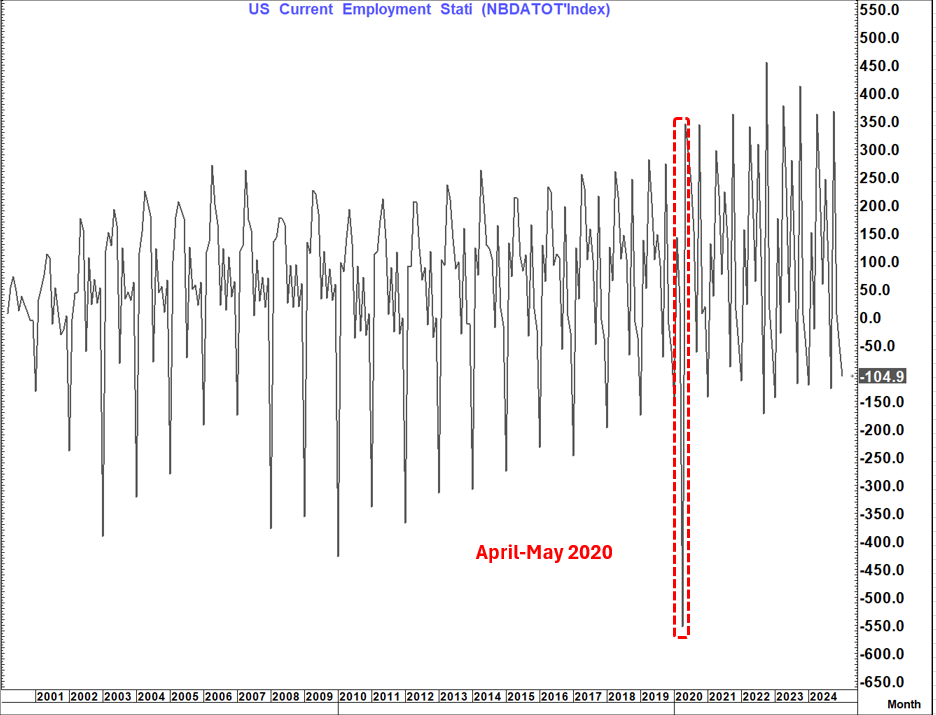
A simple classic example of this is the Birth Death Ratio which is a major element in non-farm payrolls. I prefer to call it the wallpaper chart because as you can see below it bears no resemblance to any economic cycle. It is simply a model that "calculates" the net growth or fall in jobs created in small businesses.
If we look at the chart below it bears no resemblance to any economic cycle in the past quarter century with the exception of April-May 2020 as Covid hit with force.
It is like the great Financial Crisis never actually took place.
We constantly hear today that the level of respondent numbers in a lot of these data series just become less and less as has the reliability.
Let is take the employment data:
In September we saw a drop in the employment rate driven by an unprecedented rise in Government jobs- the type of number never seen outside of Covid. That number lacked credibility, but these numbers (Household survey) do not traditionally get revised, so it sets a new "base effect"
More recently let us look at yesterday's numbers:
While we missed to the downside on NFP (as suggested we might from the fall in the Jobs Plentiful/Jobs hard to get ratio and the drop in Jolts) we saw the prior 2 months revised up.
Then there were the benchmark revisions of the benchmark revisions
As per Reuters :
WASHINGTON, Feb 7 (Reuters) - The U.S. economy created 598,000 fewer jobs in the 12 months through March than previously estimated, the Labor Department's Bureau of Labor Statistics (BLS) said on Friday.
The final nonfarm payrolls benchmark revision was less than the 818,000 reduction the BLS estimated in August. The numbers are not seasonally adjusted.
Economists had expected the level of employment over the 12-month period would be reduced by about 668,000 jobs following updates to the Quarterly Census of Employment and Wages data for the first quarter from which the BLS based the payrolls benchmark revision.
The there was the drop in the unemployment rate to 4% despite the fact that the total number of people unemployed dropped just a paltry 37k.
Somehow, we magically found that there were 2.2mm more workers around and every one of them were gainfully employed???
We did not find a single new member of the workforce that was unemployed. Shouldn't we have at least assumed that 4% of the "newfound" workers were likely unemployed as well? If they were all paying taxes, how did we not know they existed? If they were not, how do we know they exist now.?
You find $20 in your old pair of jeans. You do not somehow just find 2.2mm workers unless your statistics are grossly inefficient or worse.
The best though, has got to be the Michigan inflation expectation numbers for the year ahead.
It is just laughable. Just look at the numbers
Expected price Increases in the next year.
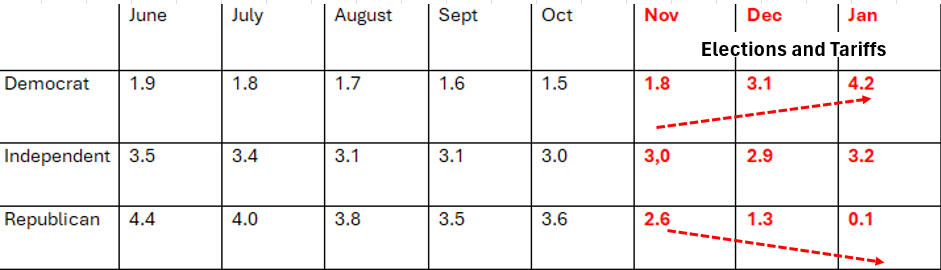
Not at all political LOL.
And this is an indicator that Jay looks at? Really?
Oh, and as an aside despite APR's at an all-time high consumer credit surged to $41bn last month.
This is the highest level since June 2022 (Fed rates were 0.75% to 1% in May and a 30-year mortgage was 5.25%.)
There is a big difference between a strong consumer backdrop driven by spending money and that fuelled by huge growth in credit at unsustainable rates.
In both 2023 and 2024 we never saw a monthly number higher than $26.5 billion, and this number is nearly double the highest December ever printed.
Either the number is false which is not good, or the consumer is now going to any lengths to maintain the post covid lifestyle, which is worse.
Previously this was driven by low borrowing rates, high savings rates, high wage increases and a huge excess of supply of jobs over available workers. While that does not make it good, it is understandable
But IF this is now being driven by increased debt at these levels of interest rates - it is potentially disastrous down the line.
I think the message here is clear
1. Garbage in- Garbage out
These numbers, the way they are collated and the way partisan politics is clearly "infecting "everything are just no longer appropriate/accurate for measuring a 21st century economy.
2. The market struggles to wean itself off what it is used to relying on, but that time has clearly come.
3. The power of the private sector/technology and AI to produce credible, in time, economic analysis is clearly now way superior to that provided by organisations such as the BLS or BS L :-).
I think we have reached a watershed moment where financial markets are going to have to demand more credible and timely analysis and look to the private sector with their wealth of data to provide it.
Soon, whether in a year, 2 years or 5 years the rumour of the death of Government statistics as a platform for financial markets to assess the economic backdrop will NOT be greatly exaggerated.
That is the end of my ramblings for this weekend. Will pop out a market note tomorrow