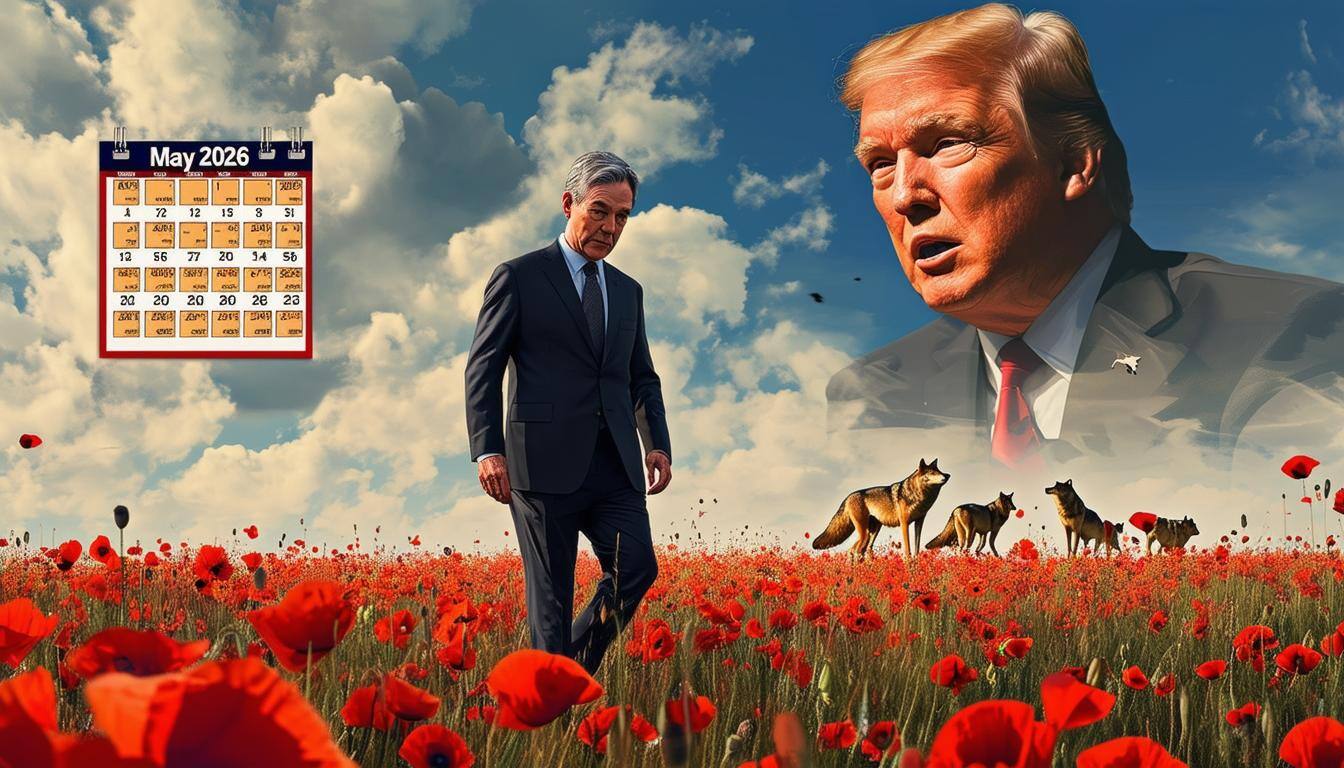
*** As I continued to write, the piece below became a whole series of "what if's" and thinking out loud.
While that may seem somewhat superfluous it is often where I get the best Germination of new ideas forming.
Sometimes it comes to nothing but sometimes it, at minimum, makes me more flexible in my view and more ready to change when and IF the time comes.****
Time will tell.
I am not there yet...BUT as I often say. "The only thing in financial markets that is unthinkable is that anything is unthinkable"
So here we go.
On of the "discussion points" last week was whether President trump had the right to "dismiss" the Chair of the Federal Reserve. Of course, he thinks he does but the general conclusion is that legally it is not clear.
However, what is likely more important is that Trump has "set the scene" that he wants lower interest rates (and lower Oil-which we have recently been getting). There remains a pretty close correlation between yields and Oil and inflation expectations so a much lower Oil price, if seen, could be a very important factor.
With Trump's other professed focus to "end wars" and Russia and Iran seeming (at least for now") more inclined to acquiesce, if all this is combined with "drill Baby Drill" could Oil be heading a lot lower?
It failed to make a breakout of the important pivotal levels at $78.50 last week (WTI) and has been falling rapidly since - down about 8% in the past week. Ther are a host of good supports below between $61.75 and $65.25 and they will be very difficult to break. However, IF they did, it would suggest the possibility of a move towards $40 which could only be described as a huge game changer.
That pretty much says to Jay that if he wants to keep his job then take rates lower. maybe he does not but I for one will be keenly listening to his words and watching his body language on 29 January (Next Wednesday)
The above also pretty much says to any "wannabee" replacement (Chris Waller maybe?) that you have just about a year (or maybe much less) to show your super-dovish credentials.
Why does any of this matter?
It matters because that suggests you either get a Powell Fed that turns dovish again (Powell Put) or Powell is set up to" lose the Fed" and the present board starts to shift dovish as we see members "jockey for position" (Powell Put Out To Pasture)
There is no implicit veto right for the Chair of the Federal Reserve just like we saw at the Bank of England with Mervyn King it is perfectly feasible that the chair can be continually outvoted and become a "lame duck"
At a minimum this would seem to potentially "dilute" the 2% inflation target mantra so should continue to support the steepening of the curve. Don't get me wrong, the 2% target is just a made-up number and whether we have 2% or 3% is less meaningful than if we have high growth and low unemployment in such a debt laden economy.
Does this mean that the backdrop is becoming more political?
Everything from Government to the Supreme court appointments to YES Central Banking/ Monetary Policy is becoming more political. Once QE started, we headed down a slippery path. Constantly in history the bond market did the heavy lifting of reducing rates all on its own during difficult times.
However, since the GFC the Fed has stepped in to that space not just to drive rates lower but because they have become the buyer of last resort for periods where fiscal stimulus is added to the "pot of recovery. We saw that in the GFC and again in Covid "
The Fed's balance sheet and funding costs are now inextricably tied to Fiscal Policy.
At the end of 2007 the Fed balance sheet stood at $891 billion. By April 2022 it was close to $9 billion. At the end of 2007 the National debt was about $9 billion and by April 2022 it was $31 trillion with a 2-year yield still depressed at 2.5% and a 10-year yield around 2.7%.
Yes, they did not buy all the new debt (closer to 40%) but their buying facilitated that huge debt growth by keeping yields artificially supressed. when the economy (Real GDP of 5.7% in 2021 and nominal of 10.1%), employment (3.6% in March 2022) and the equity market (42% higher than the pre-covid peak by Jan 2022) had already recovered strongly
So, what about the year ahead?
What is the path ahead this year for markets.
There is a very strong focus on the likelihood of higher yields in the year ahead (particularly at the long end) and that makes sense on the growth, supply, deficit, balance sheet reduction dynamics.
So, the question we should be asking is what is the "Spanner in the works" of that argument? What could create a picture of lower long-term yields?
The traditional arguments are easy. Lower growth and lower inflation and higher unemployment. But what if growth and employment hold up?
Let's sidetrack a bit to the inflation dynamic seen in the last few years starting with "transitory inflation around the World".
That was the mis-call of the decade, and we have been paying for it since on the inflation front.
But....pretty much everybody got inflation picking up strongly, not just the US. Even those without interest rate deductions like Europe and Japan.
So clearly the biggest drivers of Global inflation were supply driven from the supply shock of Covid and then the additional hit from the Russian invasion of Ukraine. Thereafter inflation fell sharply in tandem with the supply chains normalising and commodity prices falling. In particular Oil- WTI peak at $130.50 in March 2022 and fell to below $64 in March 2023 and again towards $65 in Sept 2024.
Even more pronounced was European natural gas that went from EUR15 in early 2021 to EUR 340 to EUR 345 in 2022 before falling to EUR 22-23 in 2023-2024.
So, when the ECB takes a victory lap for taming inflation it is disingenuous at best.
Inflation in Europe was not caused by a massive monetary and fiscal expansion or solved by the monetary tightening by the ECB.
It was supply driven both ways. The only effect monetary policy tightening had was to provide a zero-growth economy. Since Q3 2022 quarterly GDP in Europe has ranged from minus 0.1 to +0.4 with no growth in all of 2023.
Those numbers are rounding errors and to the extent that they have gone marginally positive again in 2024, coincided with the reduction in rates by the ECB. Shocking.
What is the point here?
Clearly (and we can see from the growth in the economy, the fall in unemployment and the rise in the US stock market) it was different in the U.S.
We clearly had both the supply shocks of Europe (albeit less so on energy) but also a demand factor from -but not restricted to.
-Huge buying of assets by the Fed depressing interest rates to artificially low levels for a sustained period of time
- Ultra low rates providing cheap once in a lifetime financing opportunities for businesses and individuals - particularly on Fixed Rate mortgages which is very peculiar to the U.S.
- Huge fiscal stimulus including Covid checks that created huge bottled-up demand once Covid ended and people got out of "Covid jail".
-Funding of the stimulus was also very cheap while the Fed depressed rates with asset buying all the way into Q1,2022
So, we literally had free money for all which unleashed animal spirits as Covid came to an end and we saw Job openings surge as a consequence to 12.2 mm in March 2022 taking us to a statistic of more than 2 job openings for every person unemployed.
How does all this look today?
The Fed is no longer buying assets, and the balance sheet has shrunk- albeit gradually to about $6.8 trillion today - still admittedly a long way above the $3.75 trillion in late 2019- nearly 5 1/2 years later.
In addition, the Fed is losing money "hand over fist" as it lets securities mature that had been yielding likely less than 2%.
The Fed lost about $114 billion in 2023 and about $85 billion in 2024 with reported unrealised losses of about $800 billion as at Q3, 2024.
These losses mean the fed has not been transmitting profits as usual to the treasury and will not be doing so until it moves back to profitability i.e. starts making money, pays off all these losses and then starts making profits again.
We no longer have ultra-low rates at any part of the curve but particularly when it comes to the most important borrowing item for US consumers- their mortgages.
A US 30-year mortgage is over 7% at the moment- not just way above the "Goldmine levels of sub 3% in 2021" but above levels going back to 1999 and also way above the sub 5% levels enjoyed from 2010 onwards.
We have continued to "Spend Baby Spend" taking the National debt up to the present levels of $36.4 trillion. This has not been predominately infrastructure/investment spending so is a big inflationary impulse. We have borrowed more money in the past 5-years than the size of the economy has increased and that is clearly unsustainable.
Our funding costs have skyrocketed directly feeding back to the budget and deficit and we now have interest rate costs close to $1 trillion a year and are spending as much on this as defense.
Unemployment quantitatively is still very low but qualitatively we appear to have been generating more low level and government jobs than anything. Job openings and total unemployed are now back in balance. As yet we do not know for sure how the new immigration policies could feed through here.
To me in a similar fashion to in Europe it is not short-term monetary policy, at the margin, that is going to move the needle in either direction on inflation- it is the interaction of the above dynamics that will be more important.
At the moment the only the only "fly in the ointment" is the open spigot of free money and unrestrained spending. If that continues how can inflation not stay sticky?
But what if we do miraculously find a way though more controlled spending combined with further deregulation, economic growth and "drill baby drill" to finance future tax cuts such that the fiscal position normalises somewhat- A big ask I agree but what IF?
Then everything seems more pre 2020 normal again and then the argument for lower rates stimulating in a non-inflationary way increases.
And what if the Fed were to pause soon on shrinking the balance sheet (not start buying anew just stop selling maturing assets).
That both reduces supply and starts to average in the Fed investment costs and if accompanied by lower rates and lower interest on excess reserves could put them into profitability quicker and therefore hasten the return of treasury remittances.
On top of this we have Tariffs and Wars. So far, the tariff dynamic seems more the "Art Of The Deal" and the Global conflict dynamics seem closer to resolution than at any time in recent years. Such outcomes would be both inflation positive and budget positive.
While the present long-term picture has been suggesting much higher yields in 2025 (That may still happen and that is the page that I have been on since late Q4,2024) all of the above is in danger of putting a spanner in the works of the bond bears and needs to be watched closely in the weeks and in particular the months ahead.
It is a lot of moving parts, and a lot of building blocks need to come together but rarely can I think of a time recently where the rates consensus has been so universally in one direction
I see some clear technical signs warning of lower rates near-term but as yet need more building blocks to suggest something bigger/ a change to the longer-term bearish view for 2025.
They are not there yet but there is clearly a potential that we need to watch for in that respect because IF that starts to happen and we spot it early....It may well be the "trade of 2025"