That tonight's gonna be a bad night, that tonight's gonna be a bad, bad night.
IF early signs in the market are any indication we are setting up for a bit of turmoil as the week begins.
In FX EURUSD in pre-trading is being suggested at about 1.0225 compared to the 1.0362 close on Friday and USDCAD at 1.4735(1.4537 close) with JPY crosses also suggested to be materially lower. Who knows where USDMXN will open up (suggestions are 2%+ higher) , but USDCNH is also suggested higher around 7.3540 (7.322 close).
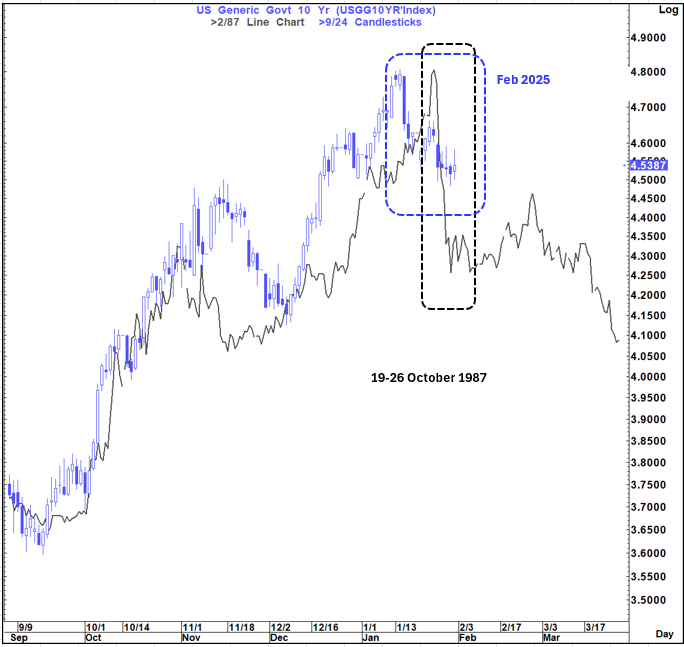
With the tariffs announced on the US side and the possibility of "counter announcements" of retaliation on the other side this has a concerning resonance with October 1987 where a lot of people think trade disputes were a catalyst that fed to the stock market crash on 19th October 1987.
The below is part of a note penned by Donald Bernhardt and Marshall Eckblad, Federal Reserve Bank of Chicago
Events Leading Up to the Crash of 1987
Stock markets raced upward during the first half of 1987,and By late August, the DJIA had gained 44 percent in a matter of seven months (Between August and December 2024 the Mag 7 index rose about 48%) , stoking concerns of an asset bubble.
In mid-October, a storm cloud of news reports undermined investor confidence and led to additional volatility in markets.
The Federal government disclosed a larger-than-expected trade deficit and the dollar fell in value. (In December the US recorded the largest ever deficit on trade in goods at minus 122.1 billion-reported on 29 January) The markets began to unravel, foreshadowing the record losses that would develop a week later. Beginning on October 14, a number of markets began incurring large daily losses. On October 16, the rolling sell-offs coincided with an event known as “triple witching,” which describes the circumstances when monthly expirations of options and futures contracts occurred on the same day. By the end of the trading day on October 16, which was a Friday, the DJIA had lost 4.6 percent.
The weekend trading break offered only a brief reprieve; Treasury Secretary James Baker on Saturday, October 17, publicly threatened to de-value the US dollar in order to narrow the nation’s widening trade deficit. On Saturday President Trump confirmed 25% tariffs on Mexico and China as well as 10% on China . Canada responded by threatening a retaliatory action of 25% tariffs on $100 billion of US goods while Mexico promised retaliatory and "tariff and non-tariff measures". China’s commerce ministry said it would file a legal case against the United States at the World Trade Organization and vowed “corresponding countermeasures.”
Even before US markets opened for trading on Monday morning, stock markets in and around Asia began plunging. Additional investors moved to liquidate positions, and the number of sell orders vastly outnumbered willing buyers near previous prices, creating a cascade in stock markets. In the most severe case, New Zealand’s stock market fell 60 percent. Traders reported racing each other to the pits to sell. In the United States, the DJIA crashed at the opening bell and eventually finished down 508 points, or 22.6 percent. "There is so much psychological togetherness that seems to have worked both on the upside and on the downside,” Andrew Grove, chief executive of technology company Intel Corp., said in an interview. “It’s a little like a theater where someone yells 'Fire!'" (Glaberson 1987).
“It felt really scary,” said Thomas Thrall, a senior professional at the Federal Reserve Bank of Chicago, who was then a trader at the Chicago Mercantile Exchange. “People started to understand the interconnectedness of markets around the globe.” For the first time, investors could watch on live television as a financial crisis spread market to market – in much the same way viruses move through human populations and computer networks.
The markets are a very different "animal" to 1987 but human nature is human nature
No, I do not expect the market to crash 22% tomorrow but this set of circumstances will clearly have woken people up from the "slumber of belief" that Trump would back down on what he had "promised" with the added wrinkle that the nations involved rather than capitulating (at least at this point) are planning to retaliate.
Markets do not like trade/economic wars and the uncertainty that they provide.
As a consequence, it is hard not to expect a pretty vicious reaction in Asia tonight.
Will this last, even if it happens?
In 1987 the fall was effectively over inside 48 hours but clearly that was a function of the magnitude/speed of the move and the fact that the Federal reserve cut interest rates by 3/8ths of a percent on 19th October 1987 (and ultimately more in Q1 1988)
They will be reluctant to do anything here unless they believe that markets are not functioning correctly.
The USD rallied from 19-22 October 1987 (flight to quality) but then fell for the rest of the year. Gold initially fell but then rallied into year end.
The US 10-year yield collapsed between the 19th and 26th October 1987 as can be seen below after previously having been in a strong uptrend.
What will happen tonight?
As we see above at least initially the USD is going to open strongly higher.
Will that be sustained? I am not so sure but that depends on other markets.
It will be hard for CAD and MXN to recover initially but USDJPY likely under pressure (next level 152.80) and JPY crosses likely very soft.
EURUSD is one that might stabilise a little.
IF USDCAD sustains above the 1.4690 level (High since 2020) there is little resistance ahead of 1.585. I am not saying it goes that far but right now it is in "open territory"
USDMXN looks like the 21.70 target is now in play If it holds over 21.00
FX market reactions have been relatively muted on an intraday basis recently and these pre-open moves suggest that other markets are going to be very volatile when they open. (FX is often used as a preopen liquid hedge for other markets)
Equity market futures are likely to fall very sharply at the open (2 to 3% at least would not be a surprise) and it may be hard for them to bounce back without some conciliatory noises. A move towards the 5,800 support on Es1 could well be a danger if 5,950 cracks.
I think the Equity fall is more important for Fixed income that the "inflation concern" of tariffs so I suspect we could see a strong F.I. rally tonight. If we do that might also mute the broad USD strength a bit. We could be on the cusp of a move towards 4.25% on 10's if we crack decisively below 4.49-4.50% and possibly as far as 4% on 5's . 2's may well test the 4.07-4.12% area
Bitcoin is already reacting badly ($97k) and a move towards $90k is not out of the realm of possibility here.
Gold is a tricky one here. safe haven or risky asset? I think safe haven might win out here but on the open it could be either way and could be a casualty of position reduction in a risk off move. Overall, though I still like it for a move to $2,900+
Good luck tonight and tomorrow and to quote Hill Street Blues "Let's be careful out there"